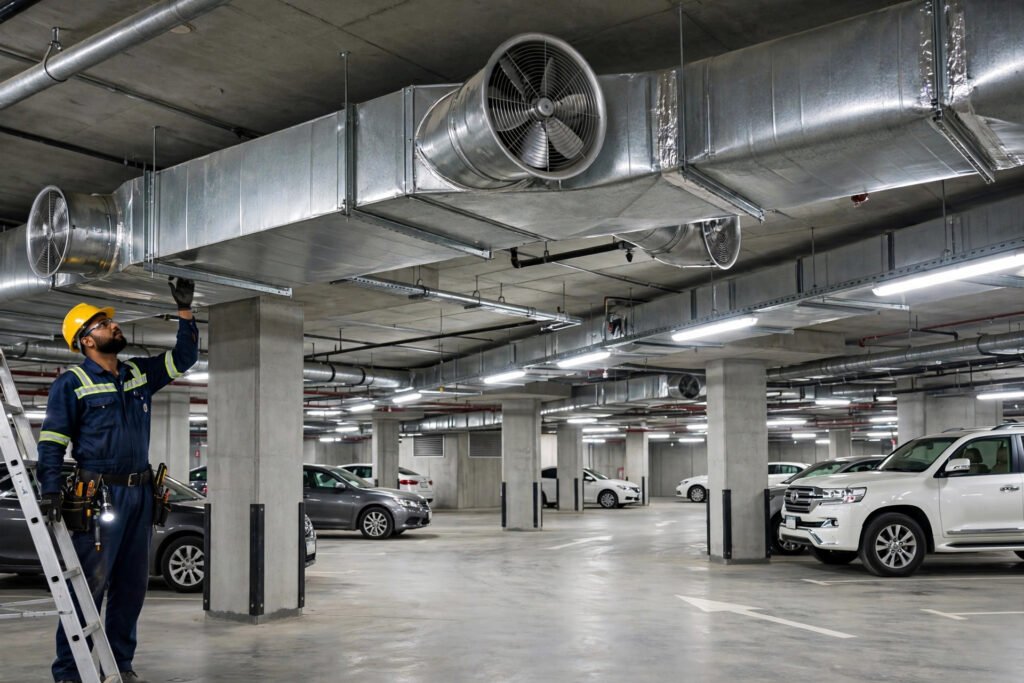
Every enclosed parking garage in Riyadh hides an invisible risk. Hundreds of cars start, idle, and circulate in sealed concrete space, releasing carbon monoxide with every trip. Without proper engineering those fumes build up fast, and this is exactly why parking garage ventilation standards exist: to keep the air safe for drivers, attendants, and everyone inside.
In Saudi Arabia, buildings with underground or enclosed parking must follow recognized mechanical codes such as the International Mechanical Code and ASHRAE Standard 62.1, which set clear parking garage ventilation standards for airflow, gas detection, and smoke control. Managers who ignore them face failed inspections, tenant complaints, and real liability.
In this guide, SheelTalab breaks down the 5 safety standards that matter most for enclosed parking garages in Riyadh, explains the numbers behind them in plain language, and shows how professional HVAC servicing keeps your building compliant year round.
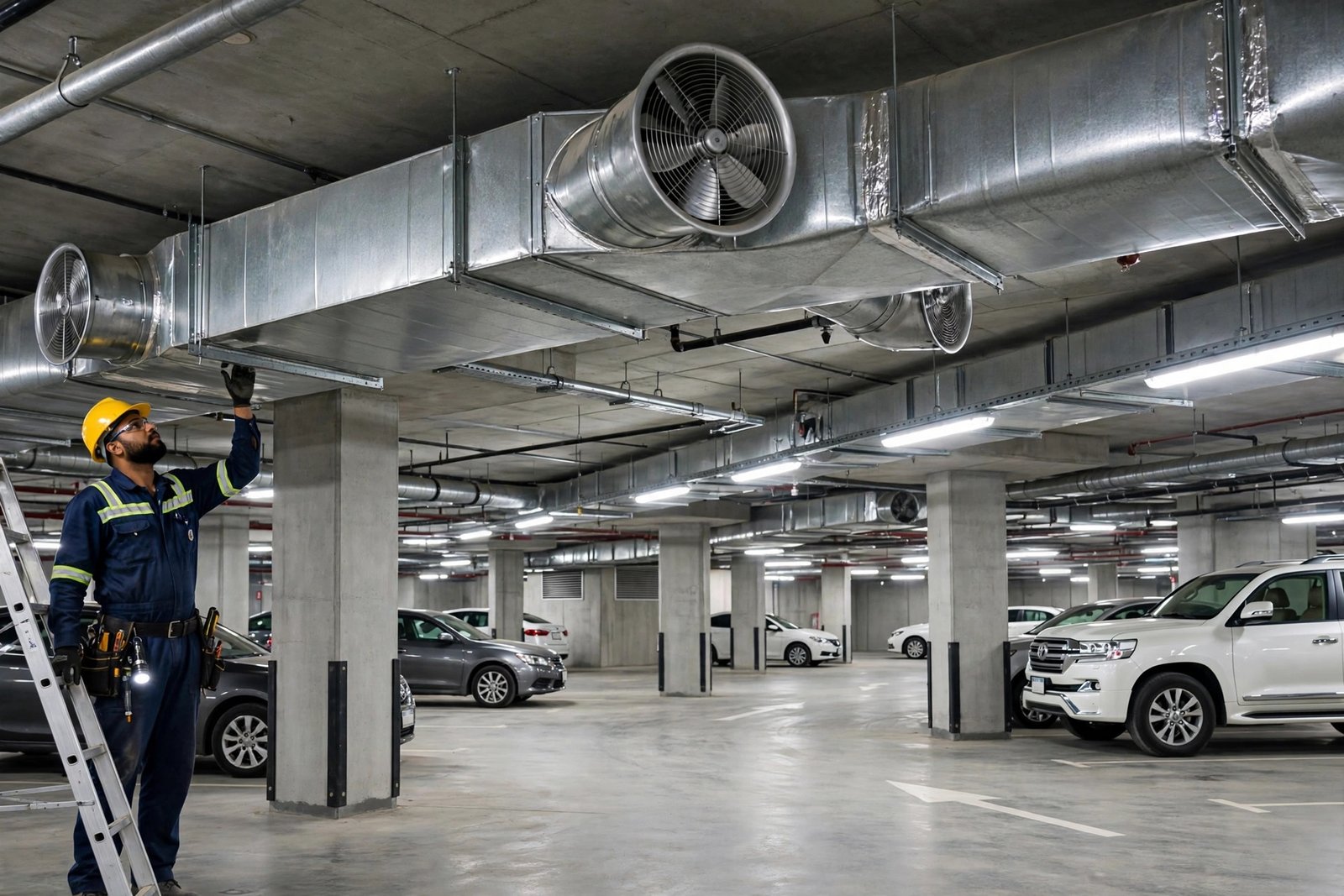
1. Carbon Monoxide Limits: The Heart of Parking Garage Ventilation Standards
Carbon monoxide, or CO, is the single biggest reason parking garage ventilation standards exist. It is colorless, odorless, and deadly in high concentrations, and idling vehicles in an enclosed garage produce it constantly. The codes therefore define the maximum CO levels allowed in the breathing zone, measured in parts per million.
Industry guidance commonly targets average CO exposure below 25 to 35 ppm over an 8 hour period, with short term ceiling limits around 100 to 200 ppm before alarms trigger. Your ventilation system must hold concentrations under these limits even during peak entry and exit hours, when dozens of engines run at once.
Why Riyadh garages need extra attention
Riyadh adds its own challenges. Summer heat pushes drivers to idle longer with the AC running, which means more exhaust per vehicle. Desert dust also clogs intake filters faster, silently reducing the fresh air your fans can move. A system that passed inspection in winter can quietly underperform by August if nobody checks it.
2. Minimum Exhaust Airflow: 0.75 CFM per Square Foot
The headline number in most parking garage ventilation standards is the minimum exhaust rate. ASHRAE Standard 62.1 and the International Mechanical Code require about 0.75 cubic feet per minute of exhaust for every square foot of parking deck, running continuously while the building is occupied. This constant dilution is what keeps CO and other pollutants from accumulating.
For a 10,000 square foot garage level, that means roughly 7,500 CFM of exhaust capacity. Just as important as the raw number is how the air moves: it must sweep from the lowest occupied level toward the exhaust points, with no dead corners where fumes can pool. Ceiling jet fans are often added to push air evenly across wide decks.
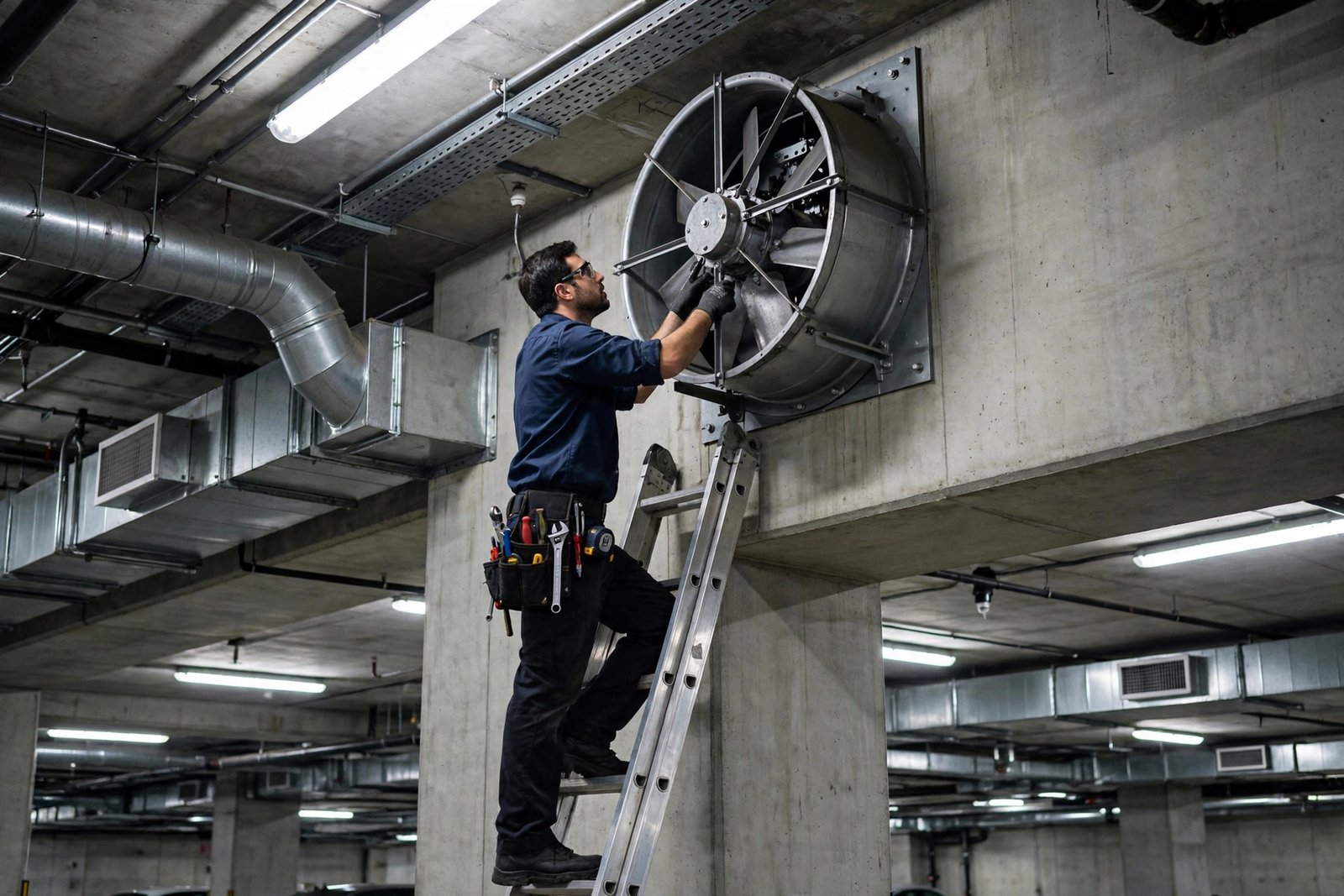
One exception: garages with two or more sides at least 50 percent open to the outside can often rely on natural ventilation. But fully enclosed and underground garages, the norm in new Riyadh towers and malls, must have mechanical systems sized to the full rate. If your ductwork is dirty or undersized, the real delivered airflow falls short of the fan rating.
3. Smoke Control and Fire Safety Integration
Daily pollutant exhaust is only half the job. The codes also cover emergency smoke control, and this is where building rules get strict. In a vehicle fire, the ventilation system must clear smoke from escape routes and keep stairwells pressurized so people can evacuate safely.
This is handled by a fire mode: when detectors or the fire alarm panel trigger, fans switch to maximum speed, dampers open along the fire zone, and smoke is pushed toward exhaust shafts. The system must operate even if normal building power fails, and it must be tested regularly, because a smoke fan seized from a year of standing idle is a common and dangerous inspection finding.
How smoke management differs from daily ventilation
Normal CO ventilation dilutes pollutants gently across the whole deck. Fire mode does the opposite: it moves large air volumes in defined paths to carve a smoke free layer along evacuation routes. Both functions often share the same fans and ducts, so the control wiring, motor starters, and damper actuators need professional inspection as one integrated system. See our central AC and commercial HVAC service in Riyadh for more.
4. Demand Controlled Ventilation With CO Sensors
Running every fan at full speed around the clock wastes a fortune in electricity. Modern parking garage ventilation standards therefore allow demand controlled ventilation: a network of CO sensors watches the air, and the fans ramp up only when pollutant levels rise above the set threshold.
When a proper sensor system is installed, codes may permit the baseline airflow to drop as low as 0.05 CFM per square foot during quiet periods, as long as the system can instantly rise to the full 0.75 CFM when gas concentrations climb. In a Riyadh mall garage that sits nearly empty overnight, this can cut ventilation energy costs dramatically while staying fully compliant.

The catch is that sensors are precision instruments. They drift out of calibration, get coated with dust, or fail silently, and a ventilation system controlled by a dead sensor is running blind. Standards expect sensors at the right heights and locations for the gases they detect, calibrated on a fixed schedule. Brucker Co.’s parking garage ventilation guide explains why meeting the code minimum on paper is not always enough in real layouts.
5. Scheduled Inspection and Maintenance
The fifth standard is the one that protects all the others. These standards assume equipment that actually works, so codes and manufacturers require regular inspection: belts, bearings, motors, dampers, filters, sensors, and control panels, all checked on a documented schedule.
In Riyadh, we recommend quarterly checks at minimum. Dust loading on coils and filters, vibration loosening on large axial fans, and corrosion on dampers in humid underground levels all degrade performance quietly. A fan drawing 20 percent less current than its nameplate usually means 20 percent less airflow, and your garage will never tell you until a CO alarm or an inspector does.
What a professional inspection should cover
A proper visit tests fan operation at every speed stage, verifies damper movement, calibrates CO sensors against a reference gas, cleans or replaces filters, checks electrical connections and motor currents, and runs the fire mode sequence end to end. Our annual HVAC maintenance contracts put garage ventilation on exactly this schedule, with a written report after every visit for inspectors and insurers.
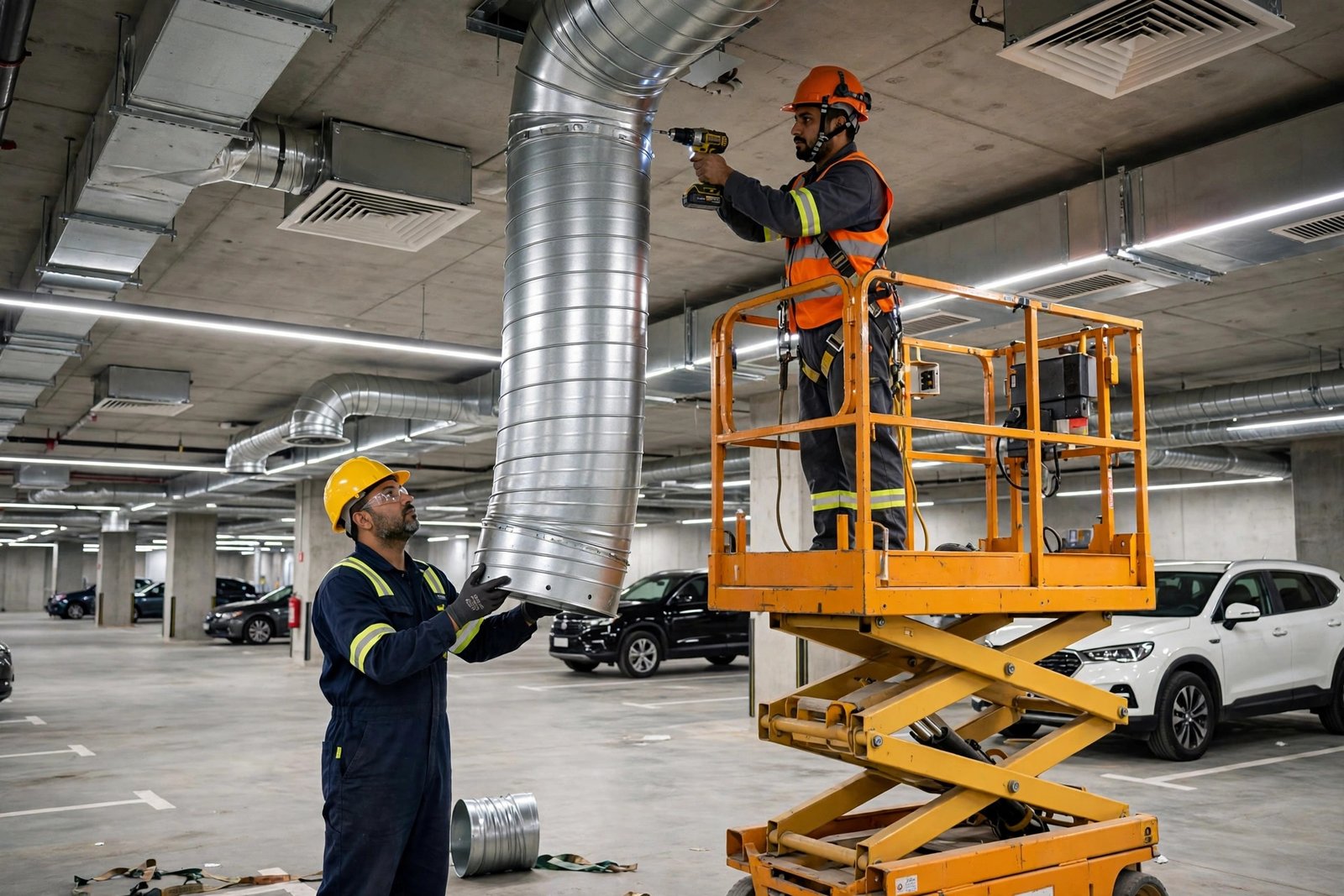
Keep Your Garage Safe and Compliant With SheelTalab
Meeting parking garage ventilation standards is not a one time design exercise, it is an ongoing responsibility. CO limits, airflow rates, smoke control integration, sensor based demand control, and disciplined maintenance work together as one system, and a weakness in any of them puts the whole garage at risk.
SheelTalab services commercial HVAC and ventilation systems across Riyadh with 45 minute rapid dispatch, 24/7 availability, certified technicians, and a 30 day golden warranty. Our Central HVAC service, from 350 SAR (was 450), covers full inspection, heavy duty coil cleaning, duct sanitization, digital airflow balancing, and motor lubrication. Call 0570328344 or 0570328344 today and we will make sure your parking garage breathes the way the standards demand.