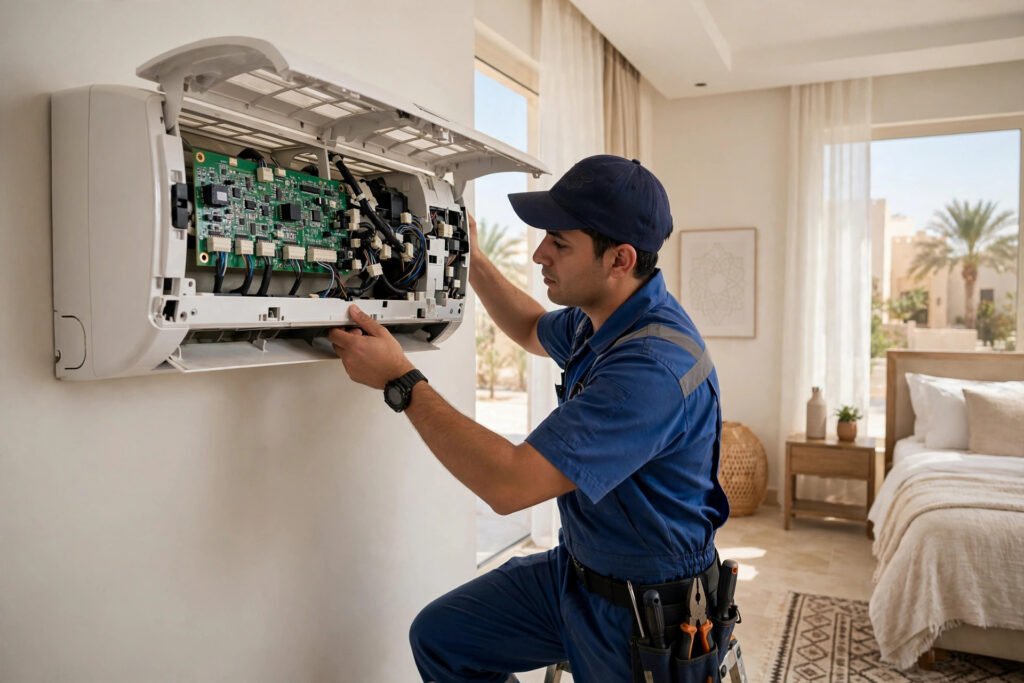
When your AC dies in the middle of a Riyadh afternoon, the fault is often not the compressor, the gas, or the fan. It is a small green circuit board hidden inside your unit. Learning the AC PCB failure signs can save you from paying for parts you do not need and gets your cooling back hours sooner, because a board-level fault behaves very differently from a refrigerant or sensor problem.
The PCB (printed circuit board) is your air conditioner’s brain. It reads every sensor, switches the compressor and fan relays on and off, and displays error codes when something goes wrong. In Riyadh’s brutal combination of 47 degree heat, fine dust, and unstable power, control boards fail far more often than most homeowners expect. Below are the six warning signs our technicians see every week, plus a simple table that helps you tell a PCB fault apart from a cheap sensor fault.
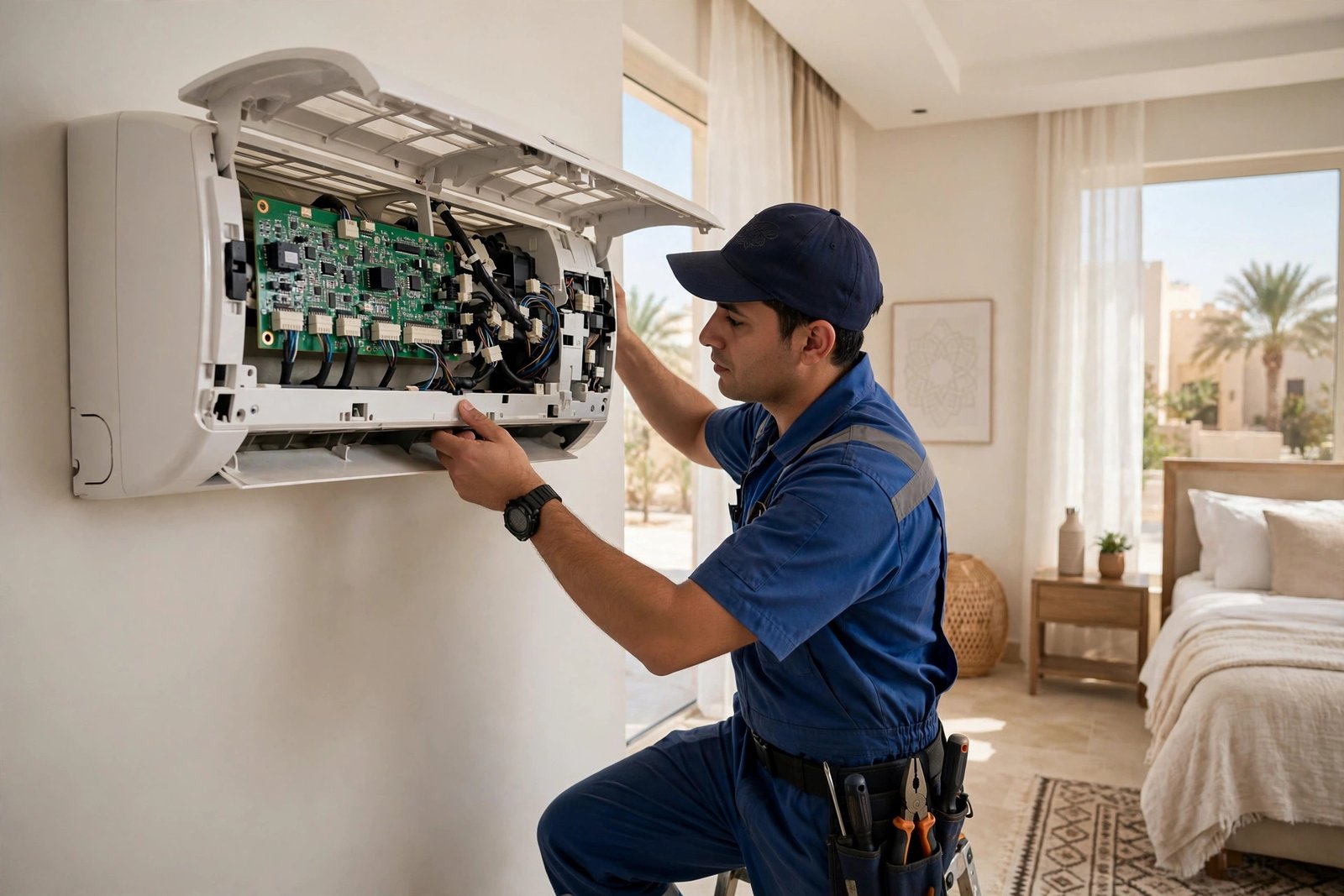
What Is an AC PCB and Why Does It Fail in Riyadh?
Every modern split and window AC contains at least one control board. The indoor PCB talks to your remote, reads room and pipe sensors, and drives the indoor fan. The outdoor PCB (on inverter models) switches the compressor. If any relay, fuse, capacitor, or copper trace on these boards burns out, the whole unit can go dead or behave strangely.
Riyadh is harsh on electronics. Summer heat soaks outdoor units for hours, dust coats boards and traps heat, and voltage spikes fry delicate components. Age also takes its toll: the compressor relay’s contacts wear down after several summers of heavy use.
6 AC PCB Failure Signs Your Split AC Is Showing
1. The AC Is Completely Dead: No Lights, No Beep, Nothing
The classic PCB symptom. The breaker is fine, the socket has power, yet the unit shows zero signs of life. Nine times out of ten this means the board’s fuse or transformer has blown, or a surge took out the power section. A sensor fault almost never kills the display completely.
2. Random Shutdowns and Restarts
The AC cools fine for 20 minutes, then switches itself off, then starts again on its own. This stuttering pattern usually points to an overheating relay or cracked solder joint that opens and closes as the board expands and contracts with heat.
3. Flashing Error Codes That Keep Coming Back
Codes like E1, E4, H6, or P4 flashing on the display mean the board has detected a fault, but when the code returns immediately after a power reset, the board itself is often the culprit. Communication errors between the indoor and outdoor boards (a very common PCB fault) trigger exactly this loop. Note the code, then let a technician verify whether the board or the component it monitors is at fault.
4. The Fan Runs but the Compressor Never Starts
You hear the indoor fan blowing, but the air never gets cold and the outdoor unit stays silent. The board energizes the compressor through a relay and contactor: if that relay has welded or burned contacts, the signal never reaches the compressor. This is one of the most misdiagnosed AC PCB failure signs, because it looks like a gas leak when it is really an electrical fault.
5. The Remote Stops Working and Manual Buttons Do Nothing
Fresh remote batteries, a clean sensor eye, and still no response, not even to the manual power button on the indoor unit. That tells you the board is not processing any input at all. When a single sensor fails, the rest of the board normally keeps working; a dead input stage means board damage.
6. Burning Smell or Visible Scorch Marks
A sharp electrical burning smell from the indoor unit, or black scorch marks and melted plastic around the control box, is the clearest sign of board damage. Turn the breaker off immediately and do not switch the unit back on. Burned traces can short and damage the compressor or fan motor, turning a board swap into a much bigger repair.
PCB vs Sensor Symptoms: How to Tell the Difference
Many AC PCB failure signs overlap with faulty sensors, and sensors are cheap while boards are not. Use this quick comparison before you agree to any repair quote.
| Symptom | More likely: PCB fault | More likely: sensor fault |
|---|---|---|
| Unit completely dead, no display | Yes: blown fuse or transformer on the board | No: sensors never kill the display |
| Error codes E2, F1, F2 (pipe or ambient sensor) | No | Yes: the named sensor has failed |
| Random shutdowns and auto restarts | Yes: overheating relay or cracked solder joint | Rarely |
| Fan runs but compressor never starts | Yes: compressor relay not switching | Sometimes, if the sensor misreads wildly |
| Burning smell or scorch marks | Yes: burned trace or relay | No |
| Display shows wrong or jumping temperatures | No | Yes: faulty room temperature sensor |
| Cools for 10 minutes, then trips the breaker | Yes: board overloading the circuit | Yes: high-pressure sensor trip |
What Does PCB Repair Cost in Riyadh?
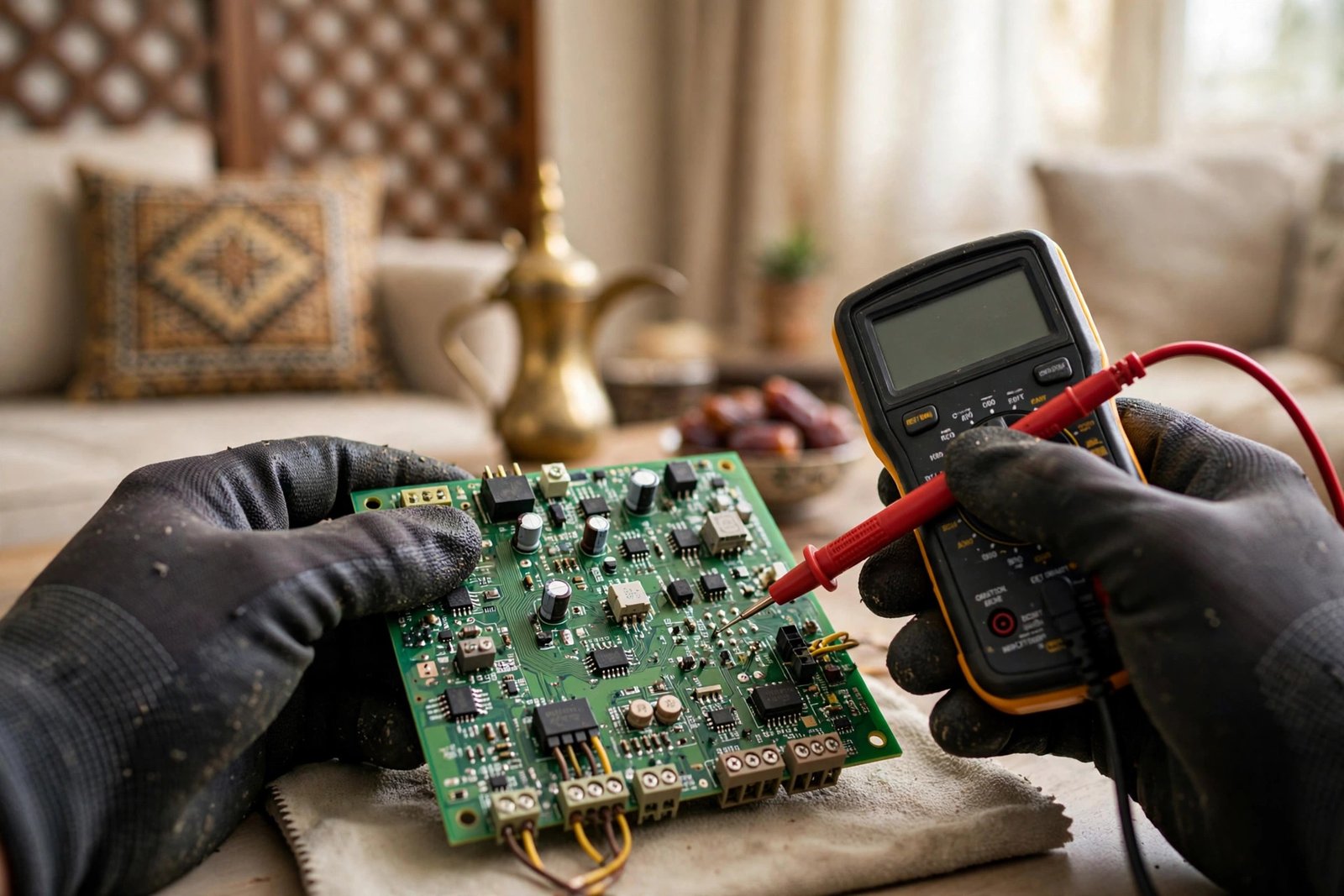
The first step is always a proper diagnosis. Our AC diagnostics and rapid repair visit is 120 SAR (was 180), and the technician tests the board with a multimeter to confirm whether the fault is the PCB, a sensor, or something else entirely. Board replacement cost depends on your brand and model, because boards are model-specific parts, but you get an exact quote before any work starts. Seeing the full picture helps: our guide to AC repair costs in Riyadh breaks down the 9 facts that keep your bill low.
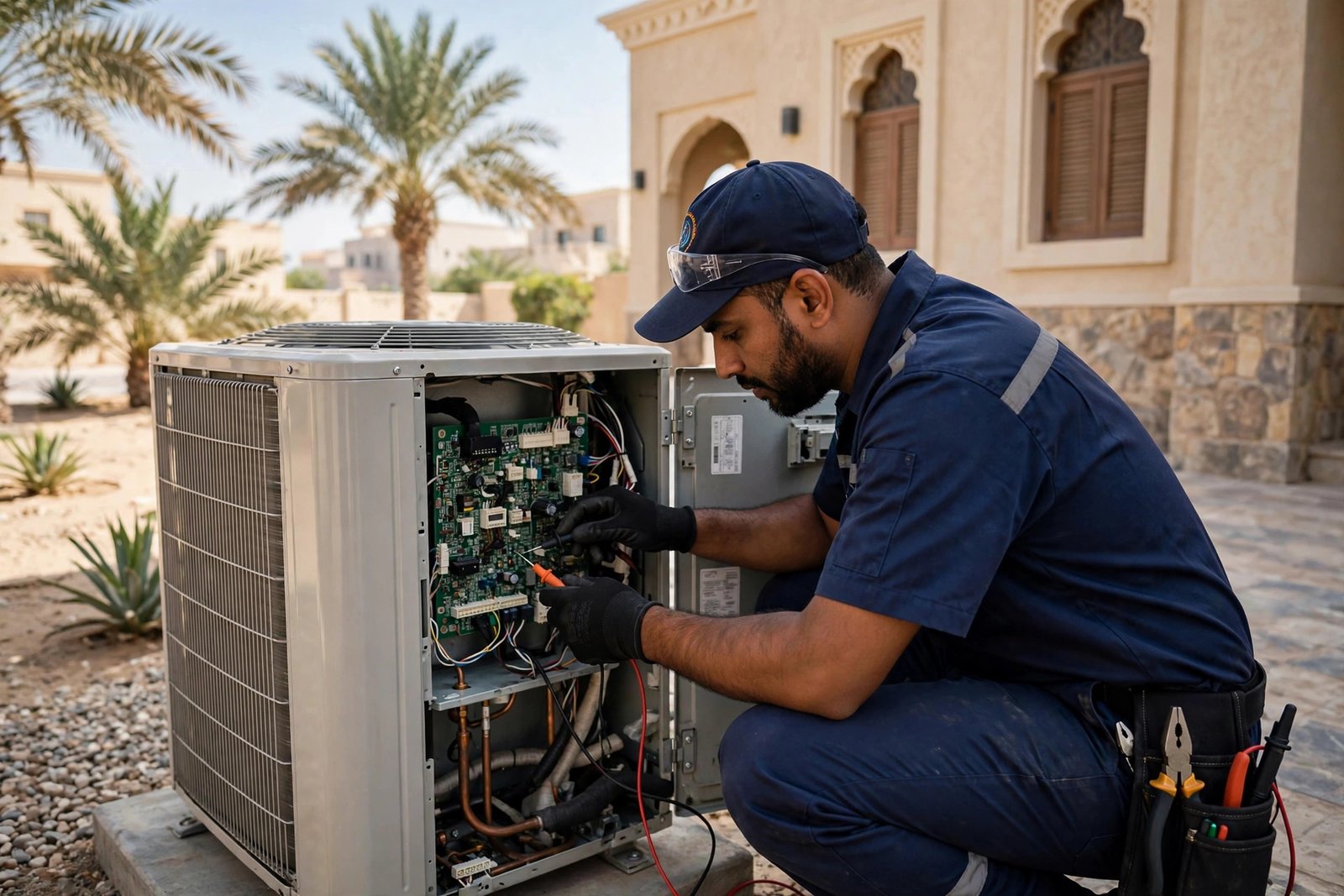
How SheelTalab Diagnoses a Failing Control Board
We never guess. Our certified technicians arrive within 45 minutes anywhere in Riyadh, 24/7, and test the board live: supply voltage, relay continuity, sensor input signals, and a burn inspection under the cover. Faulty board confirmed, we fit a genuine replacement, and every repair carries our 30-day golden warranty. More on the service: same-day AC repair in Riyadh.
Quick Checks Before You Call a Technician
Two minutes of checks can rule out the simple stuff. Confirm the circuit breaker has not tripped, try fresh batteries in the remote, and make sure the indoor unit’s display is not simply dimmed in night mode. If the unit is dead after all three, you are likely looking at one of the AC PCB failure signs above. Regular care also keeps boards alive longer: the US Department of Energy’s air conditioner maintenance guide recommends keeping electrical components clean and connections tight. And if your real problem turns out to be weak cooling rather than a dead board, our 7 fixes for a split AC not cooling walk you through that separately.
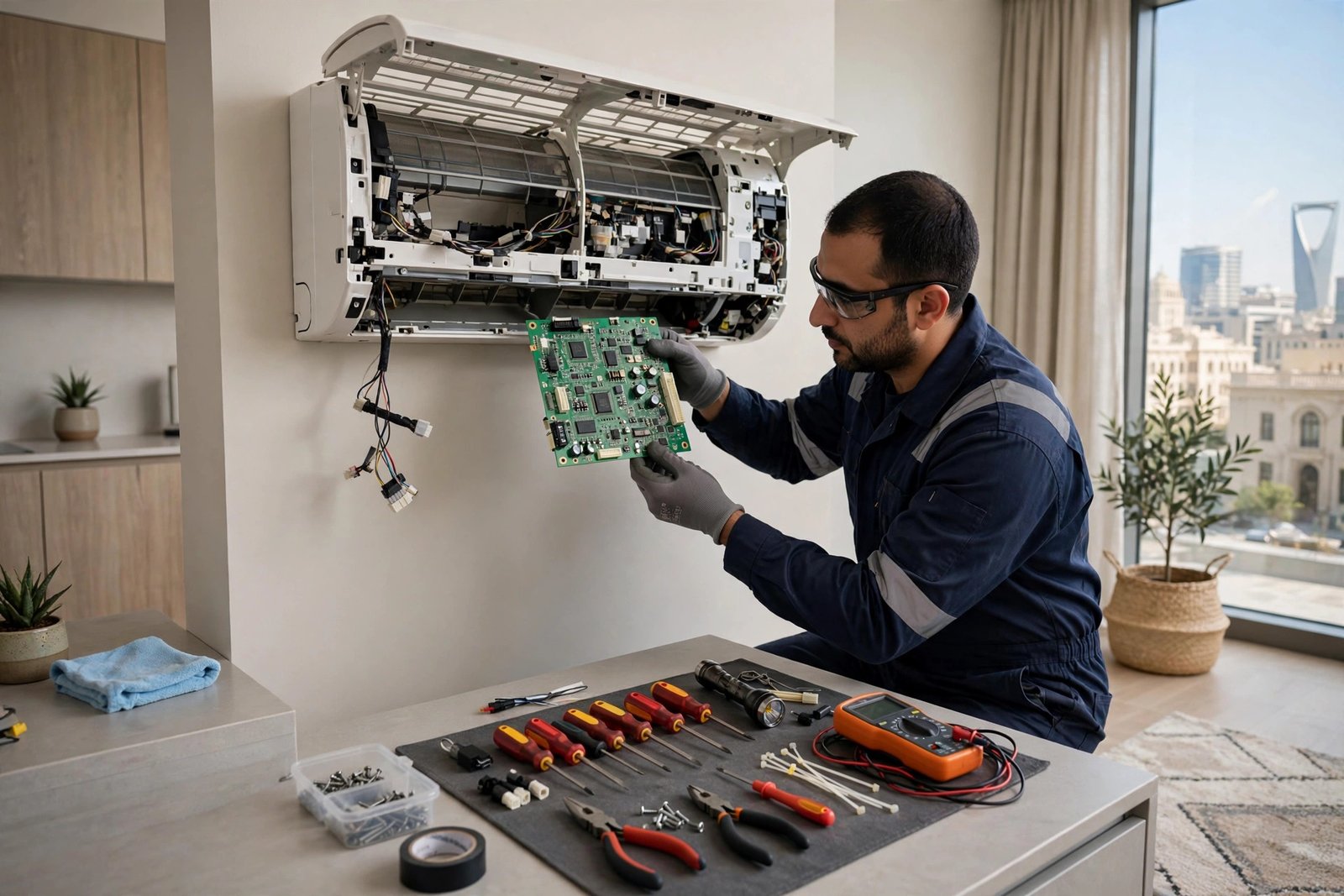
A failed control board is one of the most common reasons an AC dies in Riyadh heat, and spotting the AC PCB failure signs early is the difference between a quick board-level repair and a fried compressor. If your unit is dead, throwing random codes, or smelling of burnt electronics, get it tested before the damage spreads. Call SheelTalab at 0570328344 or 0570328344: we dispatch within 45 minutes, day or night, and our 30-day warranty backs every PCB repair.